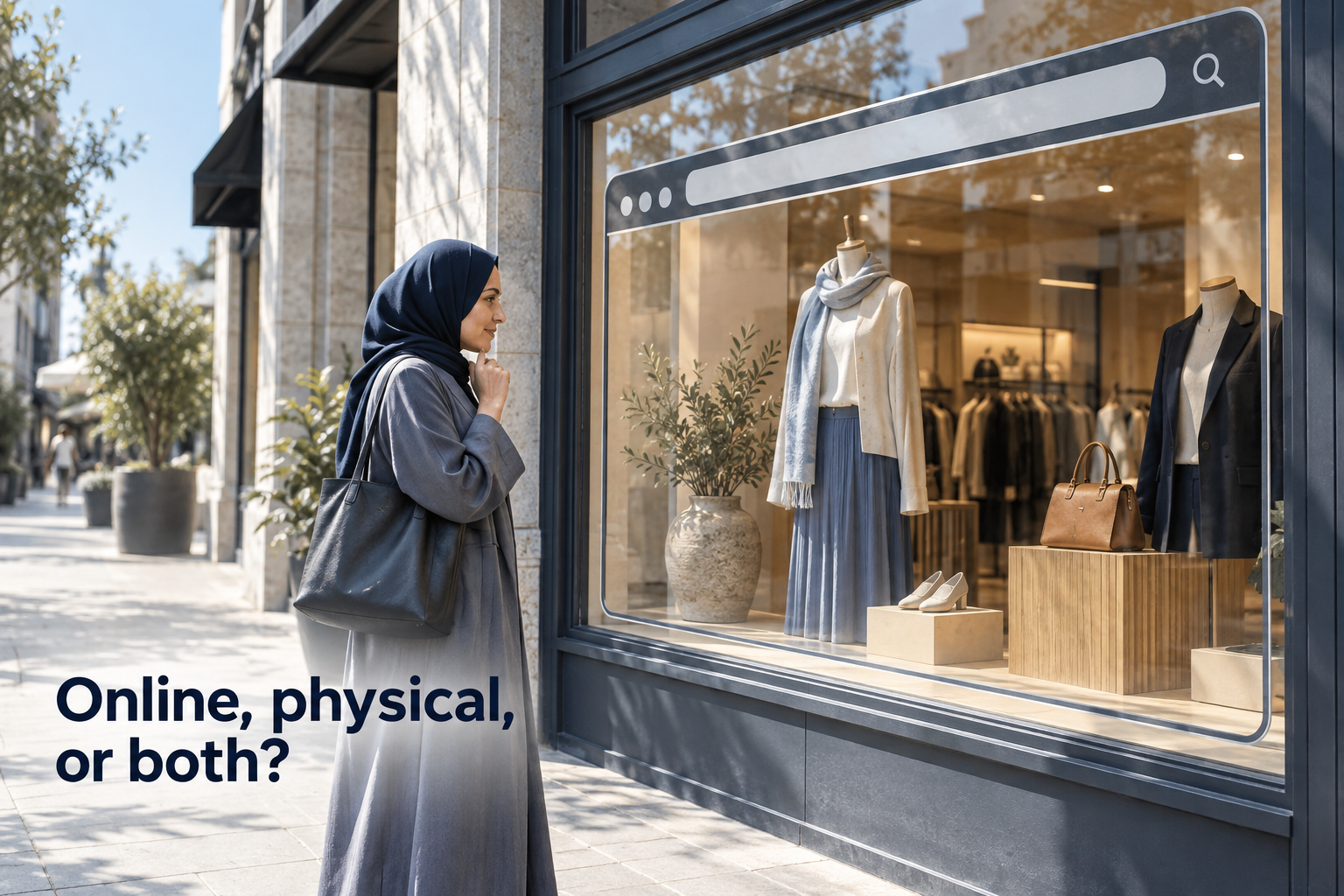
Online or physical isn't just a choice of where to sell — it's a choice between two different operating systems for your business, each with its own costs, rhythms, and daily work. Here's the honest comparison across the seven factors that actually decide it.
Startup costs and investment
Online requires far less capital to open: no lease, no build-out, no floor staff. The real costs are the website, hosting, and — the one beginners underestimate — the ongoing marketing required to be found.
Physical demands serious upfront investment: lease, renovation, staffing, utilities. What that buys is presence — a place in the community that markets itself to everyone who walks past.
Customer reach
Online transcends geography: your store is open to the world, around the clock. That reach is the model's superpower.
Physical serves whoever can get to you — a smaller pond, but one where walk-in traffic arrives with intent and leaves with bags, no shipping required.
Customer experience
Online trades touch for convenience. Live chat, recommendations, and reviews narrow the gap, but plenty of customers still want to hold the thing before buying.
Physical is the experience: examining merchandise, trying things, immediate human help. For products where feel and trust matter, this is a durable advantage — and increasingly, the experience itself is what stores sell.
Marketing
Online runs on digital: search visibility, social, email, paid campaigns — all measurable, all refinable from the data.
Physical still benefits from neighborhood presence, local advertising, and word of mouth — amplified enormously when paired with a digital layer. (No modern physical store should skip the digital marketing; the reverse blend is the point.)
Inventory and logistics
Online offers flexible stock models — including dropshipping, which removes warehousing entirely — at the cost of managing shipping economics and delivery experience.
Physical needs storage and systematic restocking, but hands the product over instantly, with no fulfillment chain to break.
Scalability
Online scales with few structural limits: bigger catalog, new markets, no new buildings.
Physical scales by opening locations — each one a full new investment in space, staff, and systems. Growth is real but expensive.
Security and risk
Online faces cybersecurity: data protection, payment fraud, uptime. Good platforms and practices manage most of it.
Physical faces the older risks — theft, damage, in-person fraud — managed with surveillance, procedure, and presence.
The honest conclusion: it's usually both
The comparison above reads like a choice, but the strongest small retail businesses increasingly run a blend: a physical presence for experience, trust, and community, and an online store for reach, resilience, and revenue that doesn't sleep.
If you're resource-constrained and reach-hungry, start online — the setup guide walks it end to end, and the systems behind online selling matter more than the storefront itself. If your product's power is in the experience, start physical and add the digital layer early. Either way, the decision should follow your resources, your customers, and what your product genuinely needs — not the model that's loudest this year.
Frequently asked questions
Is an online store cheaper to start than a physical store?
Substantially — no lease, build-out, or floor staff. The trade is ongoing marketing cost: an online store starts invisible and must be found, while a physical store markets itself to everyone passing.
Can a small business run both an online and physical store?
Yes, and the blend is increasingly the strongest model: physical presence for experience and trust, online for reach and around-the-clock revenue. Start with one done well, then add the other.
Which is easier to scale, online or physical retail?
Online — growth means expanding the catalog and markets, not opening buildings. Physical scaling works but each location repeats the full startup investment.
Not sure which model your product and resources actually point to? Start by finding where you are: find your starting point.