Business Tech Lab

Insights

Practical notes on technology, systems, and the human work around both.

  1. Illustration: A course path with visible footholds — small steps, progress markers, a community walking it together. Overlaid text reads "Keep students finishing".

    Insight

    How to engage your students and improve course completion rates

    Completion is a design outcome, not a willpower outcome. Ten practices — clear expectations, interactive content, short lessons, community, story, early wins, recognition, reminders, direct support, and feedback loops — that come straight from instructional design, not marketing.

    Read insight

  2. Illustration: One course rippling outward through several distinct channels to reach different learners. Overlaid text reads "Promote your course everywhere".

    Insight

    How to promote your online course on social media

    Posting about your course isn't promotion — a system is: pick the platforms where your students actually are, teach in public to earn credibility, build a community that promotes organically, and make the path from interested to enrolled frictionless.

    Read insight
  3. Illustration: Two chairs at the same table, one labeled user, one founder. Overlaid text reads "Run a real beta".

    Insight

    How to run a beta program: lessons from a founder and power user

    Running a beta well is a skill — not collecting feedback but structuring it, interpreting it, and making decisions from it. Lessons from both sides of the table: as a beta user inside another founder's platform, and as a founder structuring the beta for Maker Studio AI.

    Read insight
  4. Illustration: A storefront-lined street with a small, steady meter quietly running beside it. Overlaid text reads "Make your directory pay".

    Insight

    Monetizing digital directories with ads and subscriptions

    A community directory that can't fund its own upkeep dies with its first grant. Sustainable models layer advertising and subscription revenue over a free baseline — designed so monetization funds stewardship without pricing out the smallest businesses the directory exists to serve.

    Read insight
  5. Illustration: A front desk whose reception book is turning into a glowing calendar grid, appointments filing themselves in. Overlaid text reads "Booking is infrastructure".

    Insight

    Online booking for service businesses: the complete guide

    One consolidated guide to booking as infrastructure: why service businesses need online booking, how it changes the customer's experience, how automated reminders cut no-shows, and why calendar sync is the difference between a booking page and a booking system.

    Read insight
  6. Illustration: A storefront whose window doubles as a browser viewport. Overlaid text reads "Online, physical, or both?".

    Insight

    Online store vs. physical store: the pros and cons of each

    Online and physical retail are two different operating systems: one trades reach and low overhead against distance from the customer, the other trades cost and geography for presence and touch. Seven factors decide which fits — and increasingly, the answer is a deliberate blend.

    Read insight
  7. Illustration: A wall of keys on hooks, each labeled and polished, in front of doors no one is walking through; one door open with a person mid-stride. Overlaid text reads "A tool isn't ability".

    Insight

    Access and fluency: having a tool is not the same as being able to use it

    Every technology conversation measures the wrong thing: whether a solution exists, not whether the people it was bought for can actually hold it. Access is the login; fluency is the capability — and the gap between them is where tools go to be owned and unused. A working definition, the four stages between access and fluency, and what closing the gap looks like.

    Read insight
  8. The importance of your digital homebase

    Insight

    The importance of your digital homebase

    In 2015 Zakia built 75,000 followers live-streaming daily walks through Philadelphia — and lost every one of them overnight when Periscope shut down. The full story of the hard lesson: social platforms are rented land, your homebase is the ground you own, and the content and systems that live there are what no platform can take away.

    Read insight
  9. Illustration: A checklist held up against a storefront-lined street. Overlaid text reads "Choose your directory platform".

    Insight

    Top features to look for in a digital directory platform

    For an organization building a community directory, platform evaluation is a stewardship decision: search and mobile experience decide whether residents use it, profiles and reviews decide whether businesses trust it, and integrations, security, and scalability decide whether it survives year three.

    Read insight
  10. Illustration: The same prompt going into two doors: one opens onto a blank room, the other onto a fully stocked workshop. Overlaid text reads "When AI knows you".

    Insight

    What AI can do when it finally knows your business

    AI content sounds generic because the AI doesn't know the business — not because the tool is weak. When a business's context is written down once, in one place, generation stops being the hard part: the same request that produced beige boilerplate starts producing work that sounds like the business.

    Read insight
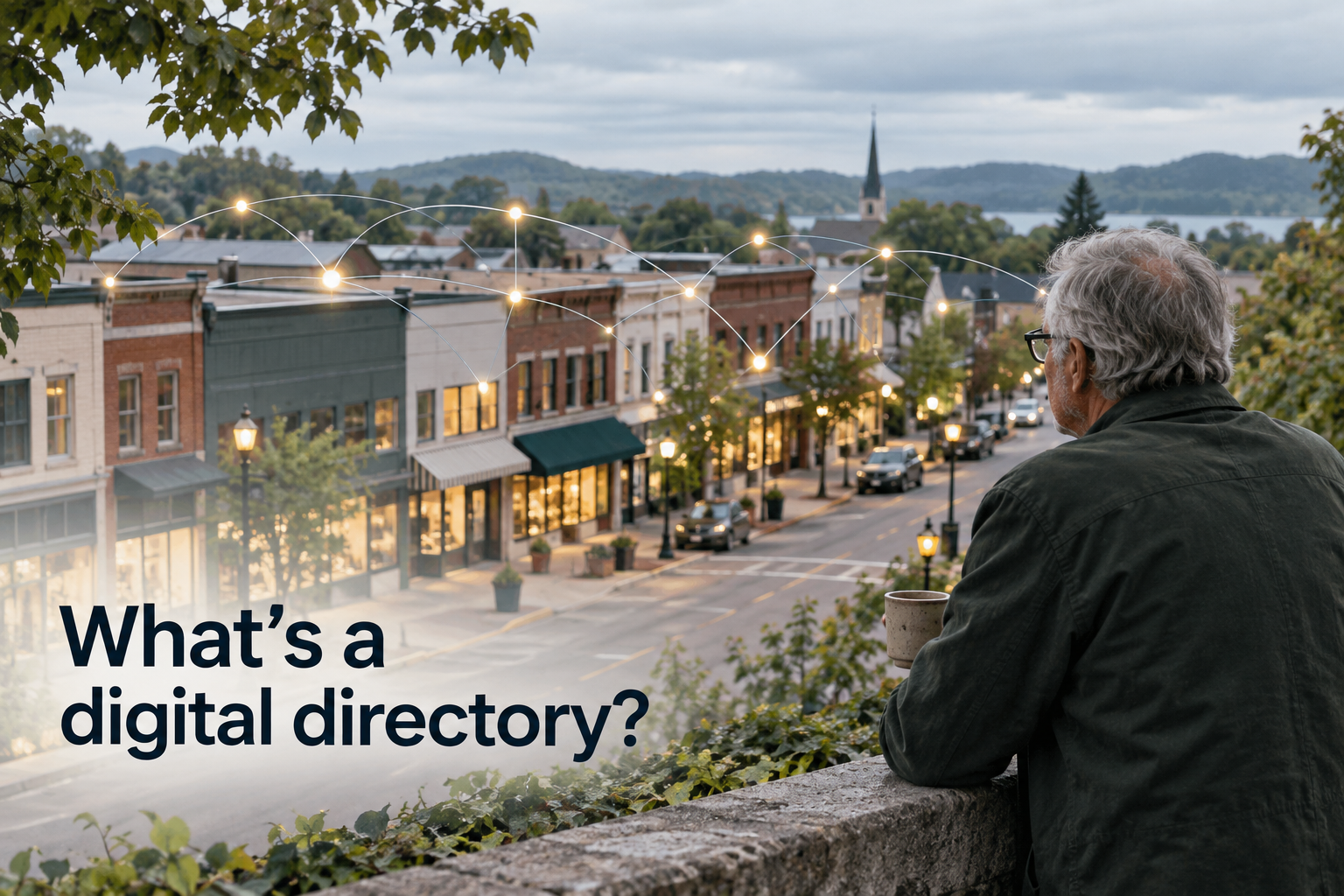
  11. Illustration: A community map where every storefront lights up on one shared grid. Overlaid text reads "What's a digital directory?".

    Insight

    What is a digital directory, and how can it help your community's businesses?

    A digital directory is an online database that organizes a community's businesses for easy discovery. For organizations that serve many businesses — chambers, libraries, municipalities, economic development programs — it's shared infrastructure: one build that raises visibility, credibility, and connection for every business at once.

    Read insight
  12. Illustration: Three keys on one ring (domain, DNS, hosting). Overlaid text reads "Who owns your website?".

    Insight

    Who actually owns your website?

    Your website rests on three things — the domain, the DNS, and the hosting — and many owners control none of them. When access and ownership are unclear, the site can go down with no one able to fix it. Here is what each piece is, who holds it, and how to take ownership.

    Read insight
  13. Illustration: A point-of-sale moment at a live event (hands, card reader, human interaction). Overlaid text reads "It's a pricing problem".

    Insight

    When the tech problem is really a pricing problem

    A business owner came to an advising session asking which payment technology to use. Thirty minutes later the real problem was visible: undefined offers, improvised pricing, and two different customer journeys forced into one. Why the technology decision belongs at the end of that sequence, not the beginning.

    Read insight

  14. Illustration: A worktable with one open notebook labeled simply 'later', everything else clear. Overlaid text reads "Unfinished ideas carry weight".

    Insight

    Why unfinished ideas create mental load at work

    Unfinished ideas are heavy because holding them costs attention — part of your focus is busy guarding something else all day. The fix isn't discipline; it's giving thoughts a place to land without deciding what they'll become.

    Read insight
  15. Illustration: A runner on a track where the lane markings simply end mid-curve, mid-stride. Overlaid text reads "It's not discipline".

    Insight

    Why consistency breaks down (and it's not discipline)

    The promised sequel to 'Your small business is already a system': consistency doesn't break because you fall off — it breaks because the system was never designed to carry you. Why motivation fades without closure, why starting over every week is exhausting, and how small, simple systems quietly protect your energy. No tech. No tools.

    Read insight
  16. Illustration: A search bar funneling into a neighborhood street. Overlaid text reads "Get your directory found".

    Insight

    How to drive traffic to your community directory with SEO

    A community directory only helps local businesses if residents actually find it. Directory SEO is mostly structural — local keywords, listing-level optimization, schema, speed — plus the content and community engagement that only the directory's steward can produce.

    Read insight
  17. Illustration: A town square rendered as a searchable interface, every storefront reachable from one doorway. Overlaid text reads "Put your community online".

    Insight

    Why every community needs a digital business directory

    A community business directory is economic development infrastructure, not a marketing product: one shared build that strengthens local businesses, keeps spending local, gives residents a working front door to their own community, and even carries essential information in emergencies.

    Read insight
  18. Illustration: A three-circle overlap (what you know, what's wanted, what transforms) with one bright center. Overlaid text reads "Choose your course idea".

    Insight

    Profitable online course ideas — and how to choose yours

    The profitable course categories barely change year to year — AI skills, marketing, tech, finance, wellness, creative skills. What decides your success isn't picking the hottest niche; it's the overlap between what you know deeply, what people actively want to learn, and what you can teach to a real transformation.

    Read insight
  19. Illustration: An org chart dissolving into a living circulatory system. Overlaid text reads "Your team is the system".

    Insight

    Your team is not a resource — they are the system

    Calling people 'resources' becomes actively dangerous in AI-enabled environments: the team is the living system AI learns from, and whatever confusion or coherence exists in the culture is what the machine amplifies at scale. Culture is not a soft variable in automation — it is the operating system.

    Read insight
  20. Four colleagues in candid conversation around a conference table, with one taking notes and a laptop closed.

    Insight

    Why most AI implementations fail long after the launch

    Most AI implementation failures trace back to organizational culture and team dysfunction, not technology. AI amplifies whatever behavioral and emotional patterns already exist, which is why teams must be stabilized before anything is automated.

    Read insight
  21. A woman seated at her desk thoughtfully studying a hand-drawn systems diagram on a whiteboard.

    Insight

    What is AI enablement? A definition from the people who practice it

    AI enablement means an organization becomes more capable — people who understand, use, manage, and decide within the systems AI touches. It is not AI training, prompt consulting, or tool implementation. Here is Business Tech Lab's full definition, what it is not, and how to know if you're ready.

    Read insight
  22. shopkeeper's hands tying twine around a tissue-wrapped purchase, separated by empty counter space from a dark tablet.

    Insight

    When AI works but customer trust disappears

    AI can make every customer touchpoint faster while trust quietly drains away. The fix isn't better technology — it's treating the customer relationship as protected infrastructure before anything gets automated.

    Read insight
  23. Two staff members compare conflicting Check first and Pack first instructions beside an unfinished order and a closed laptop.

    Insight

    Why AI fails when human systems aren't stabilized first

    AI pilots often look successful early and deteriorate later because they were designed at the machine layer and deployed into unresolved human systems. This article walks through the living layers — psychology, emotion, memory, machine behavior — one failure at a time.

    Read insight
  24. Illustration: An organization's reflection subtly diverging from itself in a mirror or glass facade. Overlaid text reads "AI's real risk: drift".

    Insight

    The real risk of AI isn't technical: it is identity drift

    The deepest risk of AI is not data security or model accuracy — it is identity drift: automated systems slowly misrepresenting who your organization is, at scale, while everything still looks operationally sound. Identity must be governed as machine-readable logic, not assumed to carry through.

    Read insight
  25. Illustration: A single lit head silhouette holding an entire storefront inside it, versus the same storefront standing on its own. Overlaid text reads "Out of your head".

    Insight

    What gets lost when your business operations live only in your head

    When operations live in your memory, the first thing you lose isn't information — it's context: why decisions were made, what customers really needed, how things were supposed to feel. Externalizing memory in small, human ways is what lets the business grow without you being the system.

    Read insight
  26. Illustration: A small desk with one calm, simple tool versus a wall of tangled apps and notifications. Overlaid text reads "Support, not another job".

    Insight

    When AI becomes another job instead of support

    By the time most owners explore AI they are already exhausted, and tools added before clarity become one more job to manage. Automation should only carry work that already repeats — one well-placed layer at a time, mapped on paper first.

    Read insight
  27. Illustration: A light fixture floating unwired beside a building's full architectural cross-section. Overlaid text reads "Architecture before tools".

    Insight

    Why AI fails when organizations start with tools instead of architecture

    Tools do not determine AI outcomes — architecture does. The same platform restores clarity in one organization and amplifies confusion in another, depending on whether four levels were designed: seeing the real system, translating human work into structure, governing machine behavior, and letting learning compound.

    Read insight
  28. Illustration: A scattered stack of documents resolving into one clean executive portfolio spread. Overlaid text reads "Reposition your leadership story".

    Case Study

    Repositioning executive leadership with AI: a VP-level case study

    A senior leader pursuing a VP role wasn't underqualified — she was under-translated. Reframing lived leadership into a coherent executive narrative, with AI as an acceleration layer rather than the author, transformed her materials from capable operator to strategic leader.

    Read insight
  29. Illustration: Scattered papers and screens consolidating into one calm audio waveform and a single organized shelf. Overlaid text reads "Learning that finally fits".

    Case Study

    Transforming graduate study with an AI learning system: a case study

    A graduate student's academic overwhelm wasn't a discipline problem — it was a mismatch between how material was delivered and how she actually learns. A centralized, searchable knowledge base with podcast-style audio summaries turned scattered pressure into an organized library: when learning matches the learner, effort turns into flow.

    Read insight
  30. Illustration: A calendar page functioning as a load-bearing beam in a small structure. Overlaid text reads "What booking systems need".

    Insight

    Top features to look for in an online booking system

    A booking system is a piece of your operating infrastructure, not a scheduling widget — so evaluate it by where it sits in your system: what it must handle (reminders, syncing, payments), how it fits your web presence, and what it does after the appointment.

    Read insight
  31. Illustration: Five differently wrapped small gifts on a shop counter, one customer's name on each. Overlaid text reads "Reward your repeat customers".

    Insight

    5 creative ways to reward repeat customers

    Beyond points and discounts: surprise gifts, VIP belonging, gamified challenges, personalized offers, and charitable giving — reward strategies that deepen relationship rather than just tally transactions.

    Read insight
  32. The beginner's guide to online booking systems for small businesses

    Insight

    The beginner's guide to online booking systems for small businesses

    An online booking system is an automated assistant that schedules, reminds, and takes payment around the clock. For a service business, it's usually the first piece of real operating infrastructure — and the first taste of what it feels like when the business carries part of the load.

    Read insight
  33. Illustration: A soap-making workbench transforming into a filmed lesson setup. Overlaid text reads "Turn skill into course".

    Insight

    How to create and sell an online course: a beginner's guide

    From corporate instructional designer to course entrepreneur: the six-step path — niche, structure, platform, production, pricing, marketing — told as capability transfer, with Live Soap School as the lived proof that teaching expertise plus your own business passion can become a real income stream.

    Read insight
  34. Illustration: Five stepping stones from a shop counter to a returning customer. Overlaid text reads "Loyalty, step by step".

    Insight

    Setting up a loyalty program: a step-by-step guide

    A loyalty program is a strategy wearing a rewards costume: define the business goal, know what your customers actually want, pick the structure that fits (points, tiers, or subscription), promote it everywhere, and let redemption data refine it.

    Read insight
  35. Illustration: A plain product card transforming mid-sentence into handwritten, sensory copy. Overlaid text reads "Descriptions that sell".

    Insight

    How to write product descriptions that boost your sales online

    Zakia's first soap descriptions listed ingredients and sizes — accurate, bland, and unsold. Descriptions are silent salespeople: speak to a specific customer, sell benefits over features, tell the real story, write for the senses, and use AI as a drafting partner that knows your business, not a replacement for knowing it.

    Read insight
  36. Illustration: A phone on a tripod filming a workbench, with a path of footprints leading from the screen to a shop door. Overlaid text reads "Why isn't it selling?".

    Insight

    Why isn't my online store making sales?

    Zakia's first marketing engine was a cellphone and a willingness to go live while making soap. The strategies that turned her store from overlooked to thriving: know your audience precisely, show the work on social, build the email list, earn search visibility, borrow aligned audiences, and let customers do the proving.

    Read insight

  37. Illustration: Ten small potholes marked on an otherwise clear road. Overlaid text reads "Avoid these email mistakes".

    Insight

    10 common email marketing mistakes beginners should avoid

    Email fails in predictable ways — untargeted lists, no personalization, clickbait subject lines, hidden unsubscribes, ignored analytics. Zakia made nearly all of these mistakes before learning better; here they are so you can skip that tuition.

    Read insight

  38. Illustration: A storefront being assembled from numbered flat-pack panels, door installed last. Overlaid text reads "Open your online store".

    Insight

    How to set up your first online store: a complete beginner's guide

    Zakia has opened online stores for handmade soap, digital courses, and consulting services — and learned that launching the website is the easy part. Seven steps take a first store from platform choice through design, fulfillment, payments, mobile, marketing, and the improvement loop.

    Read insight

  39. Illustration: A sculpture emerging rough but recognizable from a block, chisel mid-stroke, four more blocks waiting. Overlaid text reads "Launch before it's perfect".

    Insight

    The 5-step MVP method for small business

    Faced with building four different solutions at once — a high school curriculum, a community platform migration, a 12-week coaching program, and top-tier client work — Zakia escaped the perfection loop with a five-step MVP method: break down the complexity, craft the experience, make training land, choose tools outcome-first, and iterate on real feedback.

    Read insight

  40. Illustration: A mailbox with a small, sturdy lock and a clearly labeled exit path beside it. Overlaid text reads "Email law, made simple".

    Insight

    GDPR and CAN-SPAM basics: a quick primer for business owners

    Email compliance isn't a legal chore bolted onto marketing — it's trust infrastructure: honest subject lines, real consent, working opt-outs, and protected data. The two big frameworks, GDPR and CAN-SPAM, mostly ask you to run email the way good businesses already do.

    Read insight

  41. Illustration: A jigsaw puzzle mid-assembly where one piece is a browser window and several others are play buttons. Overlaid text reads "Go beyond your website".

    Insight

    Building a powerful digital presence: going beyond websites with video

    Your digital presence is a puzzle, and the website is one piece — not a prerequisite. Personalized video, guided walkthroughs, translation, and a well-built link hub let you show up with a human face before (and alongside) the website: Zakia used video capabilities to walk clients through proposals and onboard over 4,000 virtual event attendees.

    Read insight