Every small business is built under pressure. Time pressure. Money pressure. Family pressure. Customer pressure. It's part of the territory.
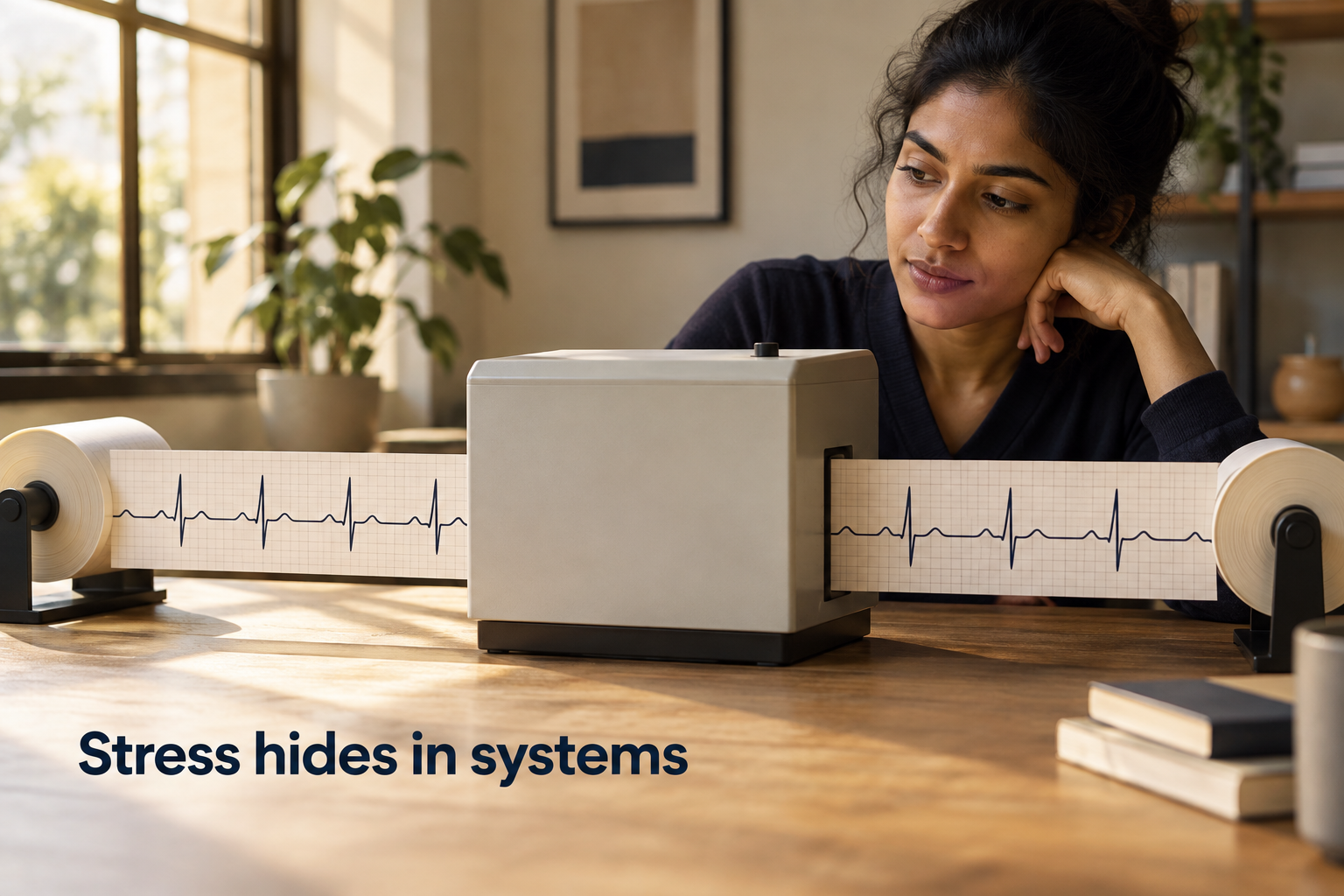
But what many owners don't realize is this: the way you operate under pressure becomes the blueprint your systems follow. When workflows are designed in urgency, AI and automation amplify that urgency rather than remove it. Designing from a calmer, intentional state lets systems buffer pressure instead of scaling it — which is the difference between operations that steady you and operations that mirror your worst weeks back at you.
When you rush, your systems learn to rush. When you work late without closure, your systems learn to stay open. When you respond from stress instead of clarity, your systems learn that tone.
Over time, those patterns stop being "how you cope." They become how your business behaves.
Why pressure isn't the problem — but unexamined pressure is
Pressure itself isn't the enemy. It's normal. It's often what pushed you to start in the first place.
The issue is when pressure becomes the default operating mode and nothing is designed to absorb it. When that happens, you build processes in a hurry, decide things late at night when you're tired, respond to customers reactively, and postpone documentation because "there's no time."
Those choices make sense in the moment. But when they get baked into how the business runs, the system quietly inherits your stress.
How stress quietly shows up in the customer experience
Customers don't see your to-do list. They feel the output of your pressure in small ways: slight delays that become patterns, short replies that feel colder than intended, unclear next steps, inconsistent follow-up.
None of this feels dramatic on any given day. But over time, it shapes how your business is experienced.
What you feel as "just trying to keep up" is often what customers feel as uncertainty.
When crisis mode becomes the default way of operating
Many owners build during crisis mode — launching under urgency, fixing gaps on the fly, learning while running. That's how most real businesses are born.
The trouble comes when crisis mode silently becomes business as usual. Years later, the owner is still operating like every week is an emergency, even when the business no longer needs that level of urgency. The systems never caught up to stability, because stability was never designed into them.
The business survived — but it never softened.
What does stress have to do with automation and AI?
Here's the part people rarely connect: automation doesn't remove pressure. It amplifies the state it's built in.
If systems are built while you're overwhelmed, the automation will move at overwhelmed speed. Faster replies, quicker orders, tighter cycles — without necessarily being calmer or clearer. AI trained on stressed workflows reproduces stressed workflows, just more efficiently.
This is why some business owners say, "I automated everything and I still feel frantic." The feeling didn't come from the tool. It came from the unexamined pressure that shaped the system. At organizational scale, this is exactly how culture trains AI — the machine learns the environment, not the intention.
Why systems built in calm behave differently
When you design systems from a calmer, more deliberate place, something very different happens. You choose fewer steps instead of more, clear handoffs instead of constant checking, defined end points instead of endless workdays.
Those choices carry forward. Your future self feels them. Your customers feel them. Your tools reinforce them.
The system becomes a buffer against pressure instead of a mirror of it. And because tone travels with state, calm systems are also how your business keeps its personal feel as it grows.
The small design shift that stops stress from being scaled
One of the most powerful design questions you can ask is not technical at all:
"When I'm stressed, what do I default to?"
Do you speed up? Shut down? Take on more? Go silent?
Once you see that pattern, you can design one small counter-move into your system. Even something as simple as a pause point, a checklist, or a daily closing step changes what gets scaled.
You're no longer scaling stress. You're scaling intention. (And if you're adding automation, the safe order is the same as always: one small, well-placed layer at a time.)
What your systems really preserve
Your systems do not just carry your work. They carry your state of being when you built them.
When you build from constant urgency, that urgency gets preserved. When you build from clarity, that clarity compounds.
The goal isn't to eliminate pressure. It's to stop letting pressure design your business for you. The next quiet risk in this series is a related one: what gets lost when your business operations live only in your head.
Frequently asked questions
How does stress affect business systems over time?
Stress shapes how decisions are made, how fast work moves, and how communication feels. When unchecked, those patterns become permanent inside business systems.
Why do some automated businesses still feel chaotic?
Because automation scales the emotional state it's designed in. If systems are built under pressure, automation multiplies urgency instead of calm.
Can AI reduce pressure in a small business?
Only if the systems it supports were designed from clarity. AI cannot correct stress-based workflows — it only accelerates them.
What is the first sign that pressure is designing my systems?
When rush becomes the default and there is no clear stopping point for the workday.
How can I prevent stress from being built into my systems?
By identifying how you default under pressure and intentionally designing one stabilizing step into daily workflows.
If your systems feel like they're keeping you in emergency mode, the fix starts with seeing what pressure built — before deciding what calm should replace it: find your starting point.