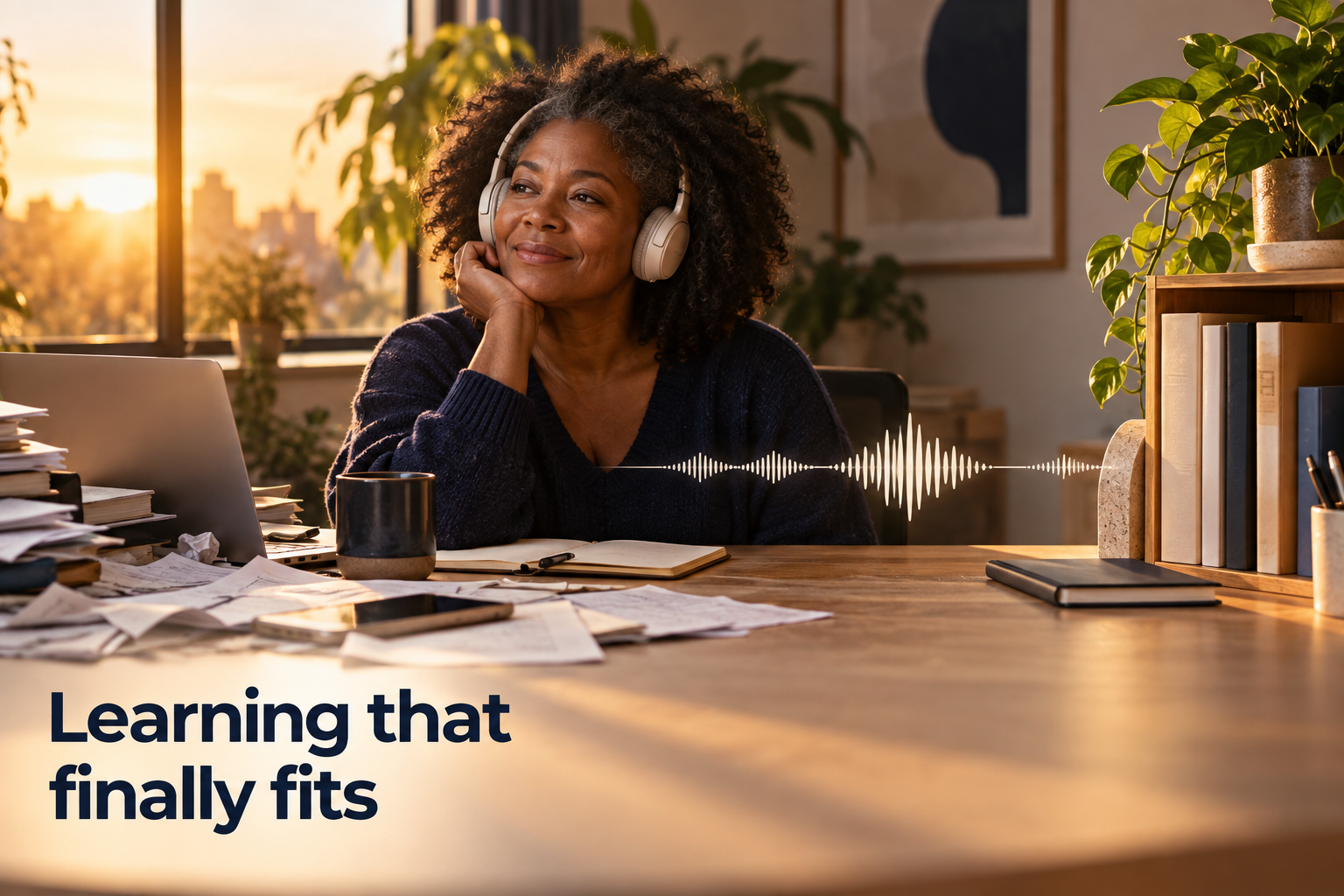
This case study examines how an AI-powered learning environment resolved academic overwhelm for a graduate student — not by improving her note-taking, but by redesigning how she experiences learning itself.
It's a small engagement with a large implication, because the mismatch it fixed is everywhere: in graduate programs, in workforce training, in every organization that delivers material one way to people who learn another.
Understand: the real shape of the struggle
The student was drowning in scattered resources across multiple platforms — recorded lectures, dense readings, disconnected materials. Her conceptual understanding was strong. What exhausted her was translation: turning all that material into a sustainable, usable study process.
Rather than starting with tools, the engagement started with her. Through conversation, her actual learning patterns became clear: comprehension was strongest through audio reflection and searchable reference, not traditional linear reading.
That understanding changed the entire design target. The problem was never her discipline. It was the mismatch between how material was delivered and how she processes information.
Advise: match the architecture to the learner
The recommendation followed directly: don't optimize her note-taking inside the existing format. Change the format. Build a personal learning environment where everything is searchable and everything important can be listened to.
Build: the learning environment
Using a Google Notebook setup, we designed an environment that:
- converted all lecture material into a searchable, centralized knowledge base,
- transformed materials into podcast-style audio summaries for listening-based learning — including review while commuting,
- reduced screen strain by letting audio carry the reinforcement work.
Nothing exotic. The design intelligence wasn't in the tool — it was in knowing what to build for this particular mind. The same AI changes its role entirely depending on where it's placed; here it was placed as a translator between the program's delivery format and the student's cognition.
Enable: what changed, concretely
- All lectures consolidated into one searchable learning system.
- Audio summaries matched to her natural learning style.
- Reduced study anxiety and improved daily consistency.
- Faster concept retrieval during assignments, with renewed academic confidence.
The shift was immediate: scattered pressure became an organized library she could enter with confidence. Study time transformed from triage into intentional work.
The core insight
"When learning matches the learner, effort turns into flow."
The largest change proved psychological rather than technical. The student no longer felt behind her program. She felt oriented within it.
What this case revealed
Academic struggle often stems from a mismatch between material delivery and how an individual actually processes information. When learning architecture aligns with cognition, anxiety decreases and confidence rises — without additional time or pressure.
AI's contribution here was reshaping the learning interface itself. System-level personalization proved more powerful than emotional motivation ever could.
For organizations, the implication scales directly: this is translation architecture applied to one learner — and the same design discipline, applied to whole training programs, is what an organizational learning companion does for every learner at once. Instructional design is the through-line: the goal was never a clever tool. It was transferring to one student the capability to run her own learning.
If the people in your program are struggling with the format more than the material, the fix is learning architecture, not more motivation: explore AI and workforce capability.