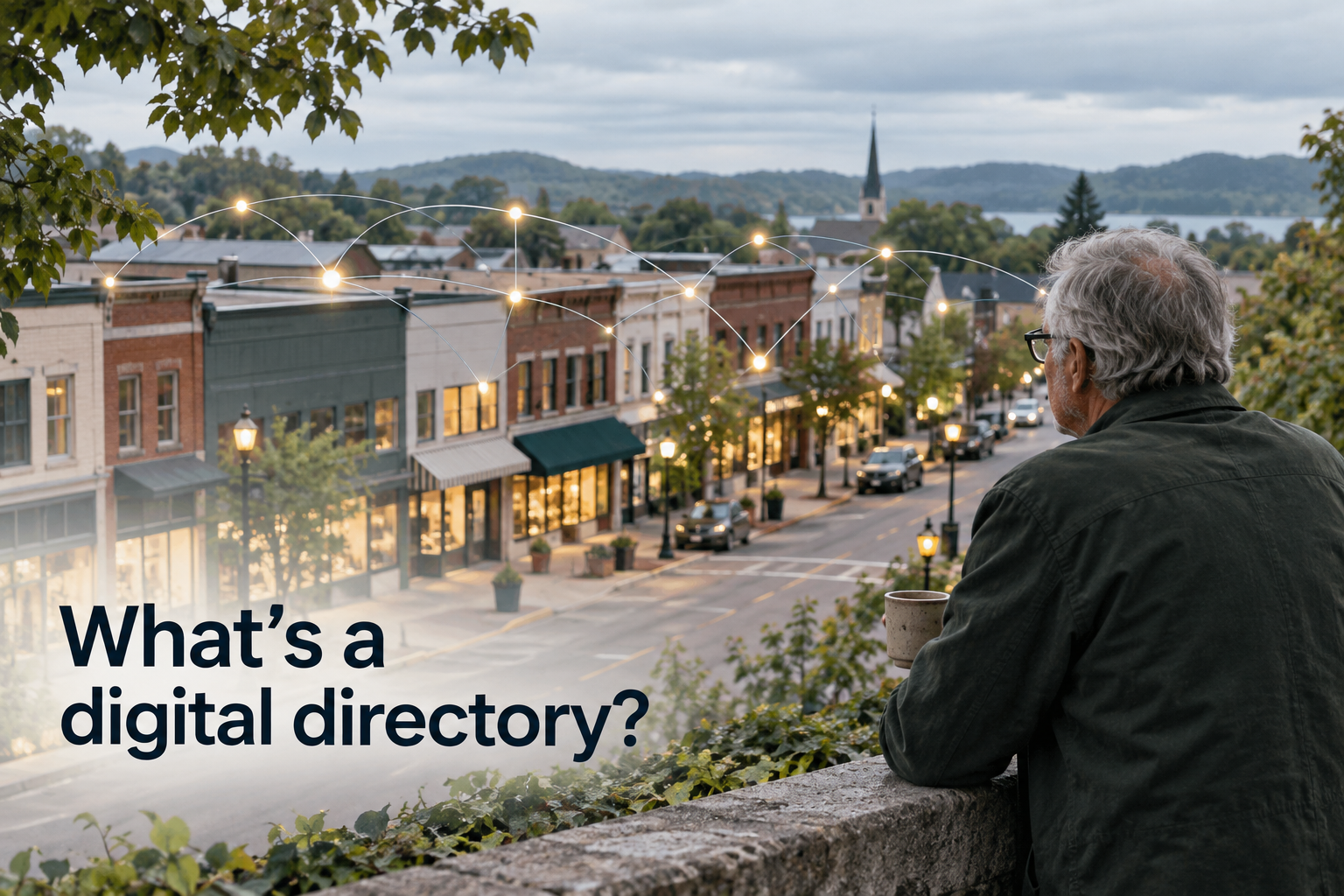
A digital directory is an online database that organizes businesses, services, and professionals so people can actually find them — searchable by category, location, or need. Think of the old phone book, rebuilt for the web, scoped to a community.
For an individual business, a directory listing is a nice visibility bump. But that's not the interesting version of this tool. The interesting version belongs to organizations responsible for many businesses at once — chambers, libraries, municipalities, main street programs, economic development organizations. For them, a directory isn't a listing. It's infrastructure: one build that raises the floor for every business in the community at the same time.
What does a digital directory do for the businesses in it?
Five things, and they compound:
Visibility. Businesses appear in relevant searches — local, category, or niche — where potential customers are actually looking. For the smallest businesses, the directory may be the only professionally structured web presence they have.
Credibility. A listing in an established, community-backed directory lends legitimacy. Customers trust businesses they find on an authoritative platform with verified information and reviews — trust a two-person shop can't easily buy on its own.
Engagement. Directories that support reviews, inquiries, and messaging give businesses a direct channel to customers without requiring each one to build and manage that channel alone.
Search traffic. A well-built directory carries real domain authority, and its listings rank. That sends organic traffic onward to the businesses' own sites — the whole community borrowing one strong web presence.
Affordable marketing. For the businesses, a listing costs little or nothing, which matters most for exactly the businesses community organizations exist to serve.
Notice the pattern: every one of these is something each business would otherwise have to build, earn, or pay for individually. The directory builds it once, for everyone. That's the scale-the-floor principle in its purest form.
How a directory sustains itself
A community directory also has to survive its first grant cycle, so its revenue models matter:
- Premium listings and featured placement — businesses that want extra prominence pay for it, while the baseline stays accessible.
- Membership and subscription tiers — often folded into an existing chamber or program membership.
- Lead generation — directories that connect providers with customers can earn on successful connections.
- Partnerships and affiliate arrangements — local collaborations that fit the community's character.
- Aggregate insight — search patterns across a community's directory reveal what residents are looking for and not finding, which is genuinely useful economic development data.
The sustainability question deserves as much design attention as the features — a directory that dies in year two teaches every listed business not to trust the next community initiative.
The real decision: whose infrastructure is it?
A directory succeeds or fails on stewardship. Someone has to own the platform, keep listings current, moderate reviews, and answer for the data. When that's designed — a staffed function, not a volunteer afterthought — the directory becomes what it should be: the community's shared front door, the case for which goes well beyond marketing.
If your organization is weighing one, start with what it must do rather than which platform to buy — the features that actually matter follow from the community's needs, not the sales page.
Frequently asked questions
What is a digital directory?
An online, searchable database of businesses, services, and professionals — organized by category, location, or niche — that helps people find and connect with them.
Who should run a community business directory?
An organization accountable to the whole community: a chamber, library, municipality, or economic development program, with a designated steward who keeps listings current and the platform maintained.
How do digital directories make money?
Common models include premium listings and featured placement, membership tiers, lead-generation fees, and partnerships — usually layered over a free or low-cost baseline listing so the smallest businesses stay included.
If your organization serves many businesses and each one is invisible in its own separate way, a shared directory is one of the highest-leverage builds available: explore ecosystem infrastructure.