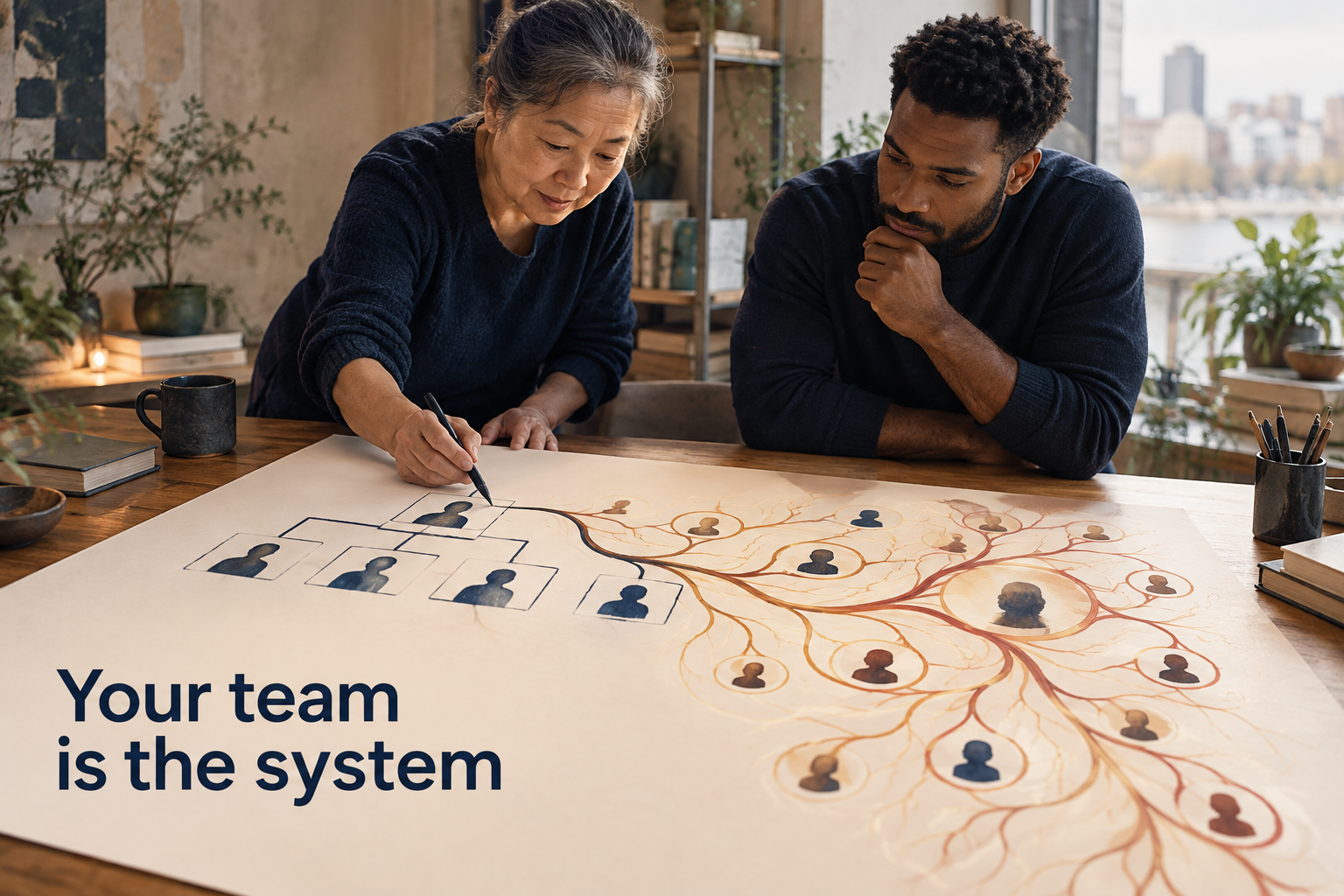
Organizations typically describe people as "resources" — headcount, capacity, labor, output. In AI-enabled environments, that framing becomes actively dangerous.
Your team is not a resource. Your team is the living system through which intelligence flows. AI doesn't learn in isolation; it learns from your team — and whatever emotional state, confusion, or coherence exists in your culture is what AI will amplify at scale.
Every assumption, emotional undercurrent, and unresolved confusion inside a team becomes training material for the machines they interact with. Once AI enters, it amplifies what already exists. Automation doesn't create clarity. It makes whatever already exists louder.
"AI doesn't introduce new behavior. It magnifies existing behavior."
Why customers feel what your team feels
A hidden feedback loop exists in every organization: team state → system behavior → customer experience.
If the team is uncertain, the system becomes inconsistent. If the team is fearful, the system becomes defensive. If the team is overloaded, the system becomes chaotic. If the team is grounded, the system becomes trustworthy.
Customers don't feel your brand strategy first. They feel the emotional residue of your internal system state. And once AI enters, that residue scales at machine speed and becomes permanent.
This is why Living Systems Architecture™ treats culture as the primary control panel, not a side variable.
Confusion is also a form of data
Most leaders believe AI only learns from documented information. It also learns from:
- how often people ask the same question,
- where workflows constantly break,
- how exceptions are handled,
- which steps teams bypass repeatedly,
- which values are stated versus practiced.
When teams are confused or misaligned, that confusion becomes behavior the machine embeds and learns from. AI does not resolve human ambiguity. It operationalizes it.
Performance problems are usually friction failures
Real-world pattern: performance challenges are often friction failures, not knowledge failures. Once structural blockages are removed and creative permission is reintroduced, momentum returns immediately.
At the team level, when teams struggle with adoption, consistency, or follow-through, the issue is rarely capability. It's almost always friction density inside the environment — and AI will automate around friction unless the environment is redesigned first.
Why culture is the real AI interface
Organizations believe their primary interface with AI is software. The primary interface is culture.
Culture determines how exceptions are handled, whether people feel safe flagging system errors, whether hallucinations are quietly ignored, whether outputs are critically reviewed or blindly trusted, and whether learning compounds or collapses into compliance.
"Culture is not a soft variable in automation. It is the operating system."
The fuller version of that argument — culture as the interface no one designs — has its own article in this series.
What happens when AI enters a disoriented team?
When AI is layered onto a disoriented team, a predictable pattern emerges: speed increases, then errors multiply, trust erodes, and people disengage.
Leadership often misdiagnoses this as resistance. In reality, it's system-level fatigue. Teams push back against being asked to move faster inside a system that no longer feels coherent. That is a design failure, not a behavioral one — the same failure pattern behind why most AI implementations fail long after the launch.
How this applies to workforce and learning systems
In workforce programs, team intelligence includes instructors, coaches, coordinators, and program managers. If these human carriers of intelligence operate under different mental models, AI will fragment learning, not unify it.
Live-to-Library systems, organizational learning companions, and AI-enabled training platforms must stabilize the humans operating the system first — not just the learners inside it. Institutional preparedness is built through the team, not around them.
The shift leaders must make now
The question to retire: "How do we use AI to make people faster?"
The question to adopt: "How do we design environments where people remain coherent as speed increases?"
That means slowing down before automating, clarifying shared meaning, stabilizing team identity, documenting real process knowledge, and governing machine behavior with lived human logic.
Without this shift, teams burn out from holding incoherent systems together at machine speed. How that pressure gets built into the tools themselves is its own quiet subject: the hidden way stress gets embedded in your business systems.
Five questions to ask at the team level
At the team level, the framework always asks five organizing questions:
- What emotional state is the team operating from right now?
- Where is confusion being quietly normalized?
- Which knowledge lives only in people's heads?
- What behaviors will the machine inherit if activated today?
- What must be stabilized before anything is automated?
These questions determine whether AI becomes a coherence amplifier or a collapse accelerator.
They are also, together, the reason Business Tech Lab's philosophy is Orientation Before Automation: locating whether a challenge is technological, cultural, emotional, or structural — before any machine is introduced. Because once the machine arrives, whatever it inherits becomes harder to reverse.
The strategic truth leaders must accept
You are not implementing AI into a neutral environment. You're placing it into a living emotional, cultural, and cognitive system that will teach it how to behave.
Your team is not a backdrop for automation. They are the primary intelligence the system will learn from.
If your organization is preparing to automate and the team's coherence hasn't been part of the plan, that's the layer to stabilize first: explore AI and workforce capability.